
Staff Writer
The Reserve Bank of Zimbabwe’s decision to introduce a 30-day ZiG-denominated term deposit facility signals a deliberate shift towards more active liquidity management as the central bank seeks to strengthen the foundations of currency stability.
The ZiG Denominated Term Deposit Facility (ZiGDTDF) Bill gives the Reserve Bank of Zimbabwe (RBZ) another instrument to absorb excess liquidity from the financial system while creating an interest-bearing avenue for investors to hold the local currency.
For the central bank, the significance of the facility goes beyond mobilising savings. Its effectiveness will largely be measured by whether it can influence liquidity conditions, improve demand for ZiG assets and reinforce confidence in the currency.
The instrument offers an 8 percent annual interest rate, which the RBZ describes as a positive real return and is available to corporates, individuals, insurance and pension funds, banks, POSB and deposit-taking microfinance institutions.
The broad investor base potentially gives the central bank access to a sizeable pool of institutional and private-sector liquidity.
“The RBZ reserves the right to accept or reject a portion of any or all tenders,” the central bank said in the prospectus, underscoring its role as an active participant in managing the amount of liquidity absorbed through the facility.
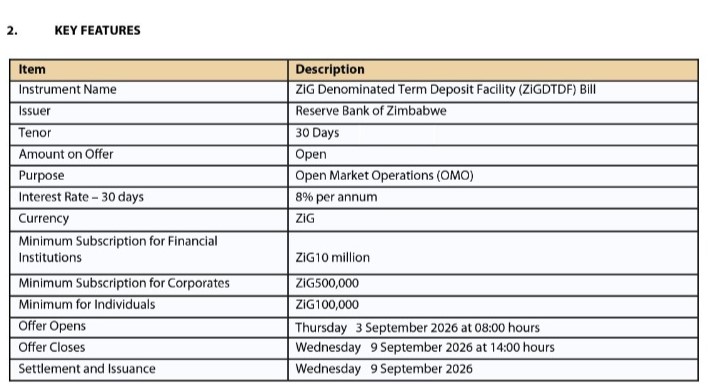
The 30-day tenor also provides the RBZ with a relatively flexible mechanism for managing liquidity without locking funds away for extended periods. This could become increasingly important as monetary authorities attempt to balance currency stability with adequate liquidity to support economic activity.
The facility carries prescribed-asset and liquid-asset status, while also being tradable and acceptable as collateral for accommodation at the central bank. These features could significantly improve its attractiveness to insurance companies and pension funds, which face regulatory investment requirements.
For the RBZ, strong participation from these institutional investors would provide an additional channel through which longer-term pools of domestic savings can be directed into ZiG-denominated instruments.
However, the real test will be market uptake. A successful subscription would provide evidence that investors are willing to hold ZiG assets when offered a credible return and appropriate liquidity features.
The initiative is therefore also a test of monetary-policy transmission. If investors respond positively, the RBZ will have strengthened both its liquidity-management toolkit and the market infrastructure supporting the ZiG.
But sustained confidence will ultimately depend on broader macroeconomic stability, particularly disciplined money-supply management, exchange-rate stability and continued preservation of positive real returns.
The offer opened on September 3 and closes on September 9, with settlement scheduled for the same day.