
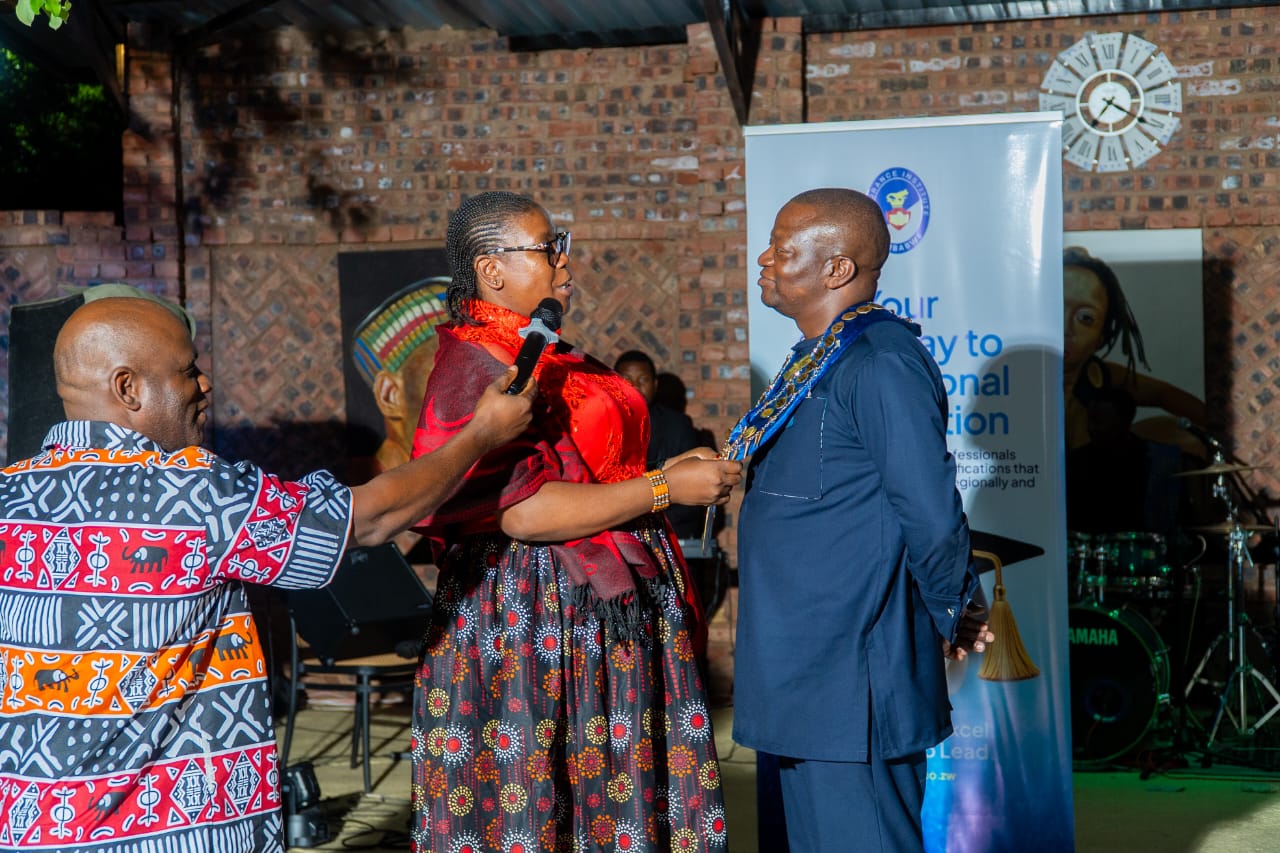
Outgoing IIZ president Dr Clementine Chinyuku handing over the presidency to Cuthbert Masukume
Nelson Gahadza
Vic Falls: The Insurance Institute of Zimbabwe (IIZ) will prioritise academic and professional excellence, regional influence, financial sustainability and institutional growth as it seeks to strengthen its standing as a leading professional body and respond to emerging challenges in the insurance industry, newly elected president Cutbert Masukume has said.
Masukume, who assumed the presidency following the handover ceremony at the conclusion of the Southern Africa Insurance Indaba 2026 in Victoria Falls, said his tenure would focus on transforming the institute into a financially resilient, regionally influential and professionally respected institution capable of supporting the industry’s evolving needs.
He outlined four strategic ambitions that will guide his leadership: positioning IIZ as a regional centre of academic and professional excellence, expanding its regional development and influence, driving revenue growth and financial stability, and strengthening the institute’s institutional balance sheet.
Speaking after taking over from outgoing president Dr Clementine Chinyuku, Masukume said the institute had reached a stage where it should stand alongside leading professional bodies in Zimbabwe, adding that insurance practitioners deserved an institution that reflected the importance and growing sophistication of their profession.
“The insurance industry of Zimbabwe has come of age and should be ranked among the leading academic and professional bodies in Zimbabwe. Same as the Institute of Chartered Accountants, we should stand tall when compared to all of these other institutions, and we should be proudly identified as insurance practitioners in Zimbabwe,” he said.
Masukume said the institute’s responsibility extended beyond managing its annual operations to building a sustainable institution capable of serving future generations of insurance professionals.
He said academic and professional excellence would strengthen the institute’s reputation, while regional influence would create opportunities for members and enhance Zimbabwe’s participation in the wider insurance sector.
Revenue growth, he added, would improve the institute’s financial capacity, while institutional balance sheet growth would provide the foundation for long-term sustainability.
Masukume takes over leadership at a time when the insurance industry is undergoing significant changes driven by technological disruption, climate change, emerging risks and evolving customer expectations.
He said these developments required insurance professionals to rethink the relevance of their work and equip themselves with the knowledge and skills needed to remain competitive in an increasingly dynamic operating environment.
He also challenged practitioners to take insurance beyond offices and boardrooms, arguing that the profession had a wider responsibility to support Zimbabwe’s economic development through improved risk protection.
He identified agriculture, mining, infrastructure, manufacturing and small enterprise development as key sectors where insurance could play a greater role in supporting economic activity.
However, he noted that significant sections of the population and the economy remained inadequately protected against various risks, making it necessary for the industry to improve insurance accessibility and public understanding.
“We must, therefore, take insurance beyond our offices and boardrooms and make it more accessible, understandable, and relevant for the communities and businesses we serve,” Masukume said.
He said financial literacy, customer education, product innovation and ethical market conduct would be critical in strengthening public confidence and improving insurance penetration.
On technological transformation, Masukume said the institute would seek to ensure members were adequately prepared to embrace artificial intelligence, data analytics and digital platforms, which are increasingly reshaping insurance operations and customer engagement.
He also identified mentorship, professional development and opportunities for emerging practitioners as important interventions in building the next generation of insurance leaders.
Masukume emphasised that achieving the institute’s strategic ambitions would require collective commitment from its eight constituent associations, corporate members and the wider insurance industry.
The associations include the Insurance Council of Zimbabwe, Life Offices Association of Zimbabwe, Insurance Brokers Association of Zimbabwe, Zimbabwe Association of Insurance Organisations, Zimbabwe Association of Funeral Assurers, Insurance Institute of Harare, Insurance Institute of Bulawayo and the Society of Fellows.
He said the institute’s strength lay in bringing together the different interests and expertise represented by these bodies under a common professional agenda.
As president, he pledged to pursue inclusive, consultative, transparent and results-oriented leadership, ensuring that all constituent associations were represented, valued and actively involved in shaping the institute’s future.
“Our success must ultimately be measured not simply by the activities we undertake, but by the value we create for our members and the contribution we make to the development of our industry,” he said.
Masukume also acknowledged the contribution of his predecessor, Dr Chinyuku, whose two-year tenure he said had seen significant institutional development and the introduction of initiatives aimed at strengthening engagement within the profession.
He cited the executive retreat and executive breakfast meetings among the initiatives introduced during her leadership, thanking her and the outgoing council for laying what he described as a solid foundation for the institute’s next phase of development.
In her farewell remarks, Chinyuku said the leadership transition represented the continuation of an institutional journey that began with the establishment of IIZ in 1982.
Drawing from 1 Corinthians 3:6, she likened the development of the institute to a process in which successive leaders planted and watered the foundations while ensuring that the institution continued to grow.
She said the names of previous presidents inscribed on the presidential sash symbolised the continuity of leadership and the shared vision that had guided the institute over the years.
“The names on the sash remind us that we have one vision and one mandate. And that mandate is what we carry forward as we carry the sash,” she said.
Chinyuku said she was handing over the presidency with humility and satisfaction, acknowledging the achievements recorded during her two-year tenure while stressing that the institute’s development remained an ongoing process.
She congratulated Masukume and the incoming leadership, expressing confidence that they would build on the progress already made and take the institution forward.
Masukume, who will serve alongside First Vice-President Kudzanayi Nyatsine and Second Vice-President Takaedza Matambo, said his ultimate ambition was not merely to maintain the institute’s operations but to transform its institutional standing and contribution to the insurance profession.
“Let us not simply aspire to manage the institute, let us aspire to transform it. Let us move forward together, united in purpose, committed to taking our profession to greater heights,” he said.


